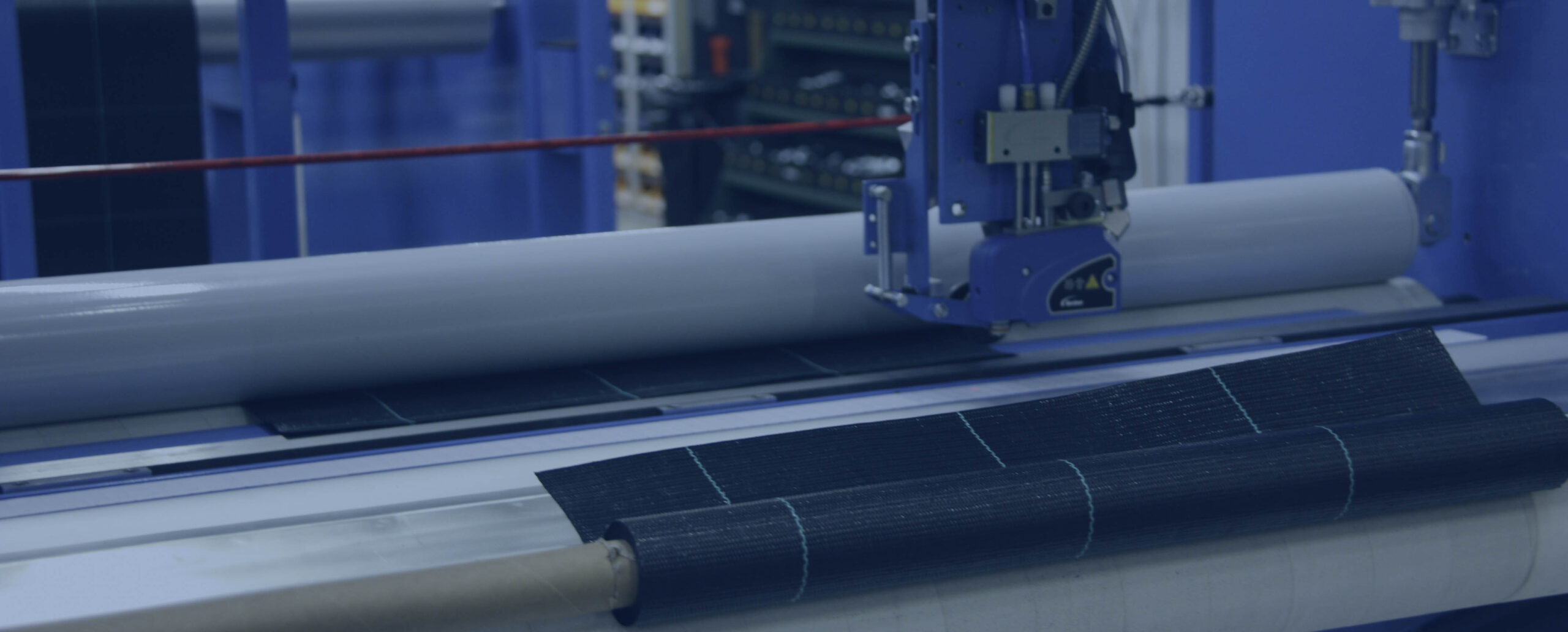
For more than 50 years, CAMPEN Machinery A/S has delivered reliable and robust converting equipment to nonwoven and technical textile producers. We design and build systems that keep your production stable and your operators in control. Understanding the difference between in-line and off-line winding is essential for optimising cost, quality, and production flexibility. Our engineering, technical expertise, and solution-oriented approach ensure your winding, slitting, and rewinding processes are efficient and safe.
In-line winding is positioned immediately after the main production process. The in-line winder matches the speed of your line, accepting the web directly with no intermediate storage or additional manual handling. This setup minimises material handling, reduces possible web damage, and conserves valuable production floor space. In-line winding is best suited for stable, repeatable product types with fixed roll formats and when your operation targets continuous, high-throughput manufacturing.
Off-line winding, conversely, is performed separately from the main line. Material is first produced into large parent rolls. Afterward, an off-line system unwinds these rolls for slitting, rewinding, inspection, or splicing as needed. Off-line winding offers the flexibility to manage a broader range of roll sizes and specifications without stopping the primary production. It allows conversion plants to fulfil diverse customer requests and handle frequent changeovers, all while the main line remains operational.
Our team can help you evaluate all relevant factors: desired line speed, roll specifications, material type, staffing, and production takt. Our decades of experience in both nonwoven and technical textile converting mean you benefit from proven, solution-driven approaches.
CAMPEN’s in-line winders and off-line slitter rewinders are designed for stability, safety, and ease of operation. Each solution is adapted to your specific production flow, whether you manage airlaid, spunmelt, carded, or composite materials. Our winding systems deliver precise tension management, clean edges, and consistent roll build quality on every run.
Our machines are built on robust frames with advanced drive and roller systems, and feature engineered safety elements such as machine guards, interlocks, and intuitive HMIs. All CAMPEN winders are easy to operate, quick to set up, and simple to maintain, helping your team sustain high efficiency and uptime.
Each production environment has unique requirements. Some manufacturers prioritise continuous in-line winding to feed directly into finishing or printing lines, while others benefit from off-line winding for flexible slitting and customised order fulfilment. Our solutions are engineered to address your specific mix of products, line speeds, and inspection needs while upholding your quality and safety goals.
We offer expertise with airlaid, spunbond, meltblown, composite, and coated technical textiles. Our team can simulate your specific scenarios, comparing impacts of different winding strategies on OEE, output rates, and operational cost per roll.
Choosing between in-line and off-line winding methods starts with a thorough production assessment. Factors to consider include production volumes, changeover frequency, available floor space, workforce size, and future scalability. Attention to safety, worker ergonomics, and integration with upstream or downstream automation is also important for selecting optimal equipment.
CAMPEN aligns each solution to your goals. Integrated in-line winders with automated roll handling support steady output, while advanced off-line systems enable adaptable production and precise tension control. Our approach delivers increased productivity, operator safety, and excellent roll quality.
Need help with your difference between in-line and off-line winding project? Talk to our engineers or request an assessment today. Learn more at campenmachinery.com/nonwoven or contact us at campenmachinery.com/contact-us.

Peder Helbo
Sales Director